Showing posts with label Optimization. Show all posts

Saturday, October 30, 2010

Python String Concatenation (again): the revenge of join!

In this second post (the first here) I proposed some benchmarks to investigate the efficiency of string concatenation in Python. I believe that the results are partial for two basic reasons:
  1. we benchmark just concatenation of huge amounts of very small strings
  2. we are creating the strings in the iteration. As a consequence, we are implicitly penalizing the methods using str.join
In this post I address the second issue. I moved the creation of the list outside the benchmarked code, and simplified the functions accordingly.
def str_sum(seq):
    out_str = ''
    for item in seq:
        out_str += item
    return out_str

def str_sum_b(seq):
    out_str = ''
    for item in seq:
        out_str = out_str + item
    return out_str

def str_join(seq):
    return ''.join(seq)

def str_join_lc(seq):
    return ''.join(item for item in seq)

def string_io(seq):
    file_str = StringIO()
    for item in seq:
        file_str.write(item)
    out_str = file_str.getvalue()
    return out_str
These are the same functions we benchmarked last time simplified where necessary. str_sum and str_sum_b are basically unchanged. On the other hand, str_join is completely different: since the first three lines where used to create the list, now they have completely disappeared.
@old_version
def str_join(loop_count):
    str_list = []
    for num in xrange(loop_count):
        str_list.append(str(num))
    out_str = ''.join(str_list)
    return out_str
As a consequence, the funcion is much shorter. I mantained the _lc variant: however, I will remove it from serious benchmarks as it is inevitably slower than the regular version. I also introduced some new functions to test here:
def str_sum_c(seq):
    return reduce(op.add, seq)

def str_sum_d(seq):
    return reduce(op.iadd, seq)

def str_sum_e(seq):
    return sum(seq, '')
They are also disabled: the _e variant is invalid Python. Calling sum on a sequence of strings gives this instructive error:
TypeError: sum() can't sum strings [use ''.join(seq) instead]
The other two were excluded because they are too slow:
itsstr_sum str_sum_cstr_sum_d
1000000.0105722.7818532.704670
Unfortunately, reduce appear to be very slow. Consider these additional functions:
def str_sum_f(seq):
    return reduce(str.__add__, seq)

def str_sum_g(seq):
    out_str = ''
    for item in seq:
        op.iadd(out_str, item)
    return out_str
itsstr_sum_bstr_sum_fstr_sum_g
1000000.0114482.8126120.018933
I decided to benchmark only a relatively small subset of the presented functions. The measures I plotted are the result of 10 executions of the function; the average time can be obtained simply dividing by 10. In the first plot I consider strings composed by numbers of fragments one order of magnitude smaller than the ones benchmarked in my other post.
In this other plot, I present the results with the same order of magnitude. However, the times presented result from 10 executions of the same function: the spikes and irregularities were not eliminated by averaging the times. Consequently, I don't consider the plot meaningful unless I discover the reason of such behavior (which comes completely unexpected).
In the future I will try a benchmark consisting of concatenation of larger strings. Technorati Tags: , , , , ,

Saturday, October 23, 2010

Python repeated string concatenation: should we change our habits?

One of the most common errors newbies do is related to string concatenation in Python. In Python, string are immutable objects; consequently, concatenating two string effectively creates a new object (and possibly releases the two former object). The common advise is to build strings using the popular str.join method.
sep.join(string_framents_sequence)
which frequently just turns into:
''.join(string_framents_sequence)
Of course, sometimes the advice goes as far as "never" ever concatenate two strings". In some sense, the advise is good, but it is often given for the wrong reasons. In fact, most of the times the '%' (or format) idiom is simply clearer. Compare:
'[%d:%d] %d %s>' % (min, hour, ret_code, path)
with:
'[' + min + ':' + hour + '] ' + ret_code + ' ' + path + '>'
Anyway, recently it has been disputed whether the str.join alternative is so much faster than repeated concatenation, given the fact that the += operator has been improved. My goal is not to investigate this matter.

Baseline

At first, I decided to benchmark this simple function:
def baseline(loop_count):
    for num in xrange(loop_count):
        str(num)
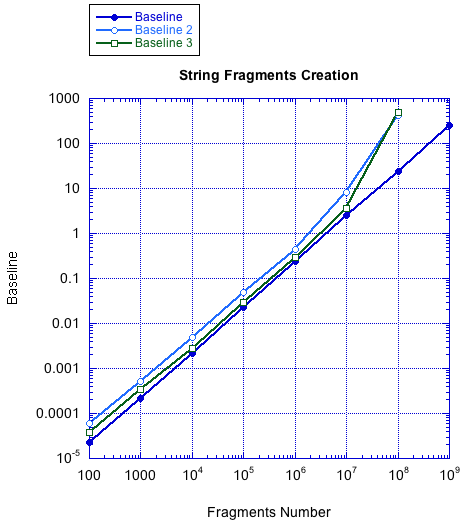
Since my first testing code is creating strings from a bunch of integer, here I am just benchmarking performance of the bare operation, without actually building the string. The second step is to accumulate all the fragments. The idea is to discover the point where thrashing starts, that is to say the range where the operation behavior remains linear. Outside these zone, we must figure out other factors and in fact the benchmark is not relevant. A third baseline tests uses list comprehensions.
def baseline2(loop_count):
    lst = []
    for num in xrange(loop_count):
        lst.append(str(num))
    return lst

def baseline3(loop_count):
    return [str(int) for int in xrange(loop_count)]
If we examine the plot of the execution times, we can see that when we keep in memory all the string fragments, thrashing starts after 107 iterations. The graph is logarithmic in both axis. As a side note, using list comprehensions is twice as fast than manually adding stuff to the list one by one. Benchmark of String Fragments Creation

Tested Code

These are the functions I actually benchmarked. Full code for the benchmark can be found in my git repository.
def str_sum(loop_count):
    out_str = ''
    for num in xrange(loop_count):
        out_str += str(num)
    return out_str

def str_join(loop_count):
    str_list = []
    for num in xrange(loop_count):
        str_list.append(str(num))
    out_str = ''.join(str_list)
    return out_str

def str_join_lc(loop_count):
    return ''.join(str(num) for num in xrange(loop_count))

def string_io(loop_count):
    file_str = StringIO()
    for num in xrange(loop_count):
        file_str.write(str(num))
    out_str = file_str.getvalue()
    return out_str
str_sum is essentially string concatenation using operator +=. str_join and str_join_lc are string concatenations performed with str.join. The str_join_lc variant uses list comprehensions. string_io is a StringIO based method (here it is the StringIO from cStringIO). Code has been adapted from the code benchmarked here. However, I decided not to use the `` operator, even though it is faster. Since it is going away from Python, I believe it is not relevant anymore. Moreover, using str in place of `` uniformly slows down all the methods.

Results

In this graph, I present results relative to Python2.6. Essentially, nowadays the faster method to create the strings has been proven to be the once advised str.join. However, I believe that difference is not great enough to change habits.
Here I present also plots for Python 2.7 and Python 2.6; essentially there is no significative difference with relative results. Python 2.7 is just faster than Python 2.6 with every considered method (and Python 2.5 is slower).
So, it appears that indeed concatenating strings with the += operator is simply faster. Out of curiosity I also tried a variant:
def str_sum_b(loop_count):
    out_str = ''
    for num in xrange(loop_count):
        out_str = out_str + str(num)
    return out_str
and I found no real difference with the variant with +=. Wow! The benchmark was executed on my MacPro. Python2.5 and Python2.6 are the Python variants distributed with the OS (Snow Leopard). Python 2.7 has been dowloaded from Python.org. In this other post I investigated string concatenation using pre-built list of string fragments. The results are quite different, indeed! Technorati Tags: , , , ,

Sunday, October 17, 2010

Anagrams: fast python algorithm

So in this post I showed how the trivial algorithm to compute anagrams is stupid (and consequently slow) beyond hope. On the other hand I promised a nice algorithm to do that. In fact, it is just a matter of pre-processing the data. The idea is to compute a key which is unique to all the words which have the very same letters and then group all the words with the same key. One of the simplest keys could be a bag of the letters (if your language supports bags -- or multi-sets --). Python sets have unique keys, so they are not a good candidate. However a "sorted" variant of the word has the right properties. Every word with the same letters (which is the definition of palindrome) yields the same string if we sort its letters. A good structure is a dictionary with this key as key and a list of strings as value. When we find a string with a previously found key, we add it to the list of strings, otherwise we generate a new list. This is the very popular setdefault idiom:
d.setdefault(key, []).append(w)
The key for a word of length n is computed in O(n log n), insertion in the dictionary is O(1) (get the key is O(1) in average and append to the list is O(1)). So the algorithm uses rather efficient elementary operations. At this point "general" questions on the processed wordlist can be answered in O(M) if M is the number of the words (e.g., longest anagram, word with most anagrams). Simply getting the anagrams of a given word is an O(n log n) operation. We are not using an excessive amount of memory. We basically have an hash-table and some "pointers" to the original words. And now the code:
class Anagrams(object):
    def __init__(self, dictionary):
        self.dictionary = dictionary
        self.indexed_words = {}
        self.preprocess()

    def make_key(self, word):
        sorted_word = list(word)
        sorted_word.sort()
        return tuple(sorted_word)

    def preprocess(self):
        for word in self.dictionary:
            key = self.make_key(word)
            self.indexed_words.setdefault(key, []).append(word)

    def anagram(self, word):
        key = self.make_key(word)
        return tuple(self.indexed_words[key])

    def anagrams(self):
        return [anagrams for key, anagrams in self.indexed_words.iteritems()
                if len(anagrams) > 1]
As a matter of fact, if we extend the corpus of words, the required time increases. In fact, using the dictionary from here it took 4 whole seconds. Which is nonetheless a lot less time than some million of years. I did not use that dictionary because it contains lots of misspells which can have sense when computing Levenshtein distances, but are quite a PITA if we compute anagrams (we don't want non existing words to popup as solutions).

Technorati Tags: , , , ,

Saturday, October 16, 2010

Anagrams and (brains vs. cpu)

In AI there is a vast category of algorithms which follow a (blind) generate and test strategy. They essentially "generate" the solutions (as a whole or step by step) and then test if the solution complies with an acceptance function. Unfortunately, this simple strategy is usually ineffective. The cost is often exponential in the size of the input and since there is no "intelligence" all solutions (even dumb ones) are explored). In AI it is customary to use smarter search techniques (A*) or to "change" the problem so that even smarter solutions are viable. An apparently unrelated example, is "finding the anagrams of a word". The trivial (and generate and test) solution is:
  1. [generate]: try all the permutations of the word
  2. [test]: check if the word is in the dictionary
and this strategy also shares the very same problems of the other generate and test strategies. All the permutation of a k characters word are k! = k(k-1)(k-1)...2. It is customary to see algorithms like:
def yield_anagrams(dictionary, word):
return [word for word in
(''.join(candidate) for candidate in it.permutations(word))
if word in dictionary]
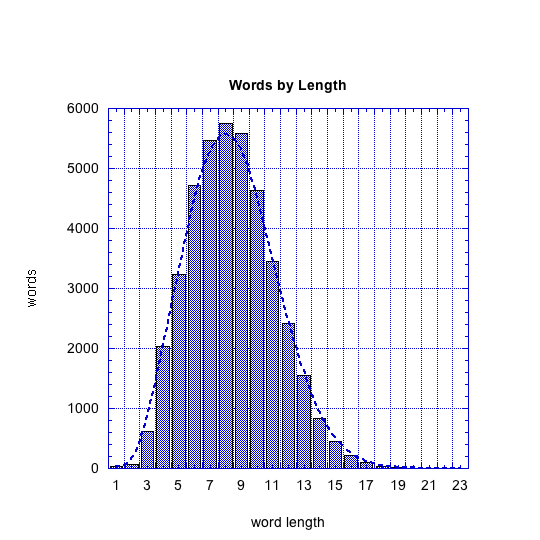
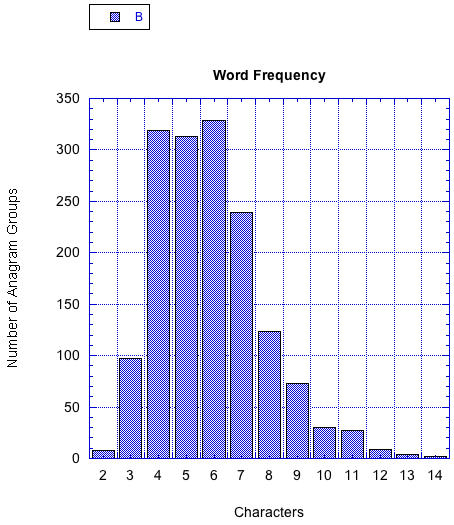
which in other languages are even longer and less attractive. This approach is rather tempting for very small words. I got some interesting wordlists from here. As a good starting point I used the 12Dict list and in particular the 2of12.txt file. More info on the lists can be found in the ReadMes. In the rest of the post we are going to work with that dictionary. This graph shows the distribution of word lengths: Distribution of Words by Length This other graph shows how many groups of words with the same anagram we have by word length: Frequency of Anagram Groups by Word Length For those preferring tabular data:
Size of the wordNumber of groups
28
397
4319
5313
6329
7239
8124
973
1030
1127
129
134
142
As we can see, the longest words with anagrams are 14 characters long. Even though most anagrams are very short word, our algorithm should work reasonably well with every input. The code I showed cannot. For example, let us consider the time required to compute the anagrams of words of increasing size:
scoreless90,174
praetorian101,828
rationalize1121,03
indiscreetly12269,0
LinearLinear Graph of Performance Computing Anagrams in a Naive Way In the first graph, we both axes are linear. If we do not believe me when I say that the growth is exponential, then look at this other graph: here the y axis is in logarithmic scale. Exponential means that if you simply change the implementation or the implementation language, things are going to blow up once again a couple of steps later. LinearLog Graph of Performance Computing Anagrams in a Naive Way So, let us sum up: we have 41238 words. Of these words, 5644 have 12 or more characters. If we suppose that anagrams for words longer than 12 character cost exactly as anagrams for words 12 characters long, the whole process is going to take 1518236 seconds, that is to say more than 17 days. In fact, the whole process is going to be far more expensive. I have a full table (excel -- here you may want to download the file --, csv) with times estimated using the formula derived from our 4 values. Of course, this is not extremely precise, but the sheer magnitude of the computed values should make the point clear. To compute all the anagrams for all the words up to size 11 (included) it takes one day. If you want to reach size 13 it is going to take one year. However, it is still a long way to process all the words... for example, in order to discover that our dictionary words with anagrams of length 15, our program is going to run for more than 38 years. The conclusion that no words longer than 14 has an anagram (according to our dictionary) takes more than 4000000 years. Of course, I did not wait all that time to gather these results... tomorrow I am showing a smarter strategy which drops the required time from 4000000 years to 0.16 seconds.

Technorati Tags: , , , ,

Sunday, September 5, 2010

Multi-scheme implementation of roman: performance

In order to confront the different implementations of simplify-all with multiple scheme variants, I removed all the racket specific code. I implemented by hand missing functions (foldl) or got their implementations otherwise (sort, from Freeley in the gambit lib directory). I also have some measures of different implementations all in Racket.

The resulting program still runs with racket, of course. In fact, I found rather annoying to perform the test as, for example, some implementaion provide an add1 function (so I have to comment out the definition) while some others miss that builtin (and they need my implementation).

Benchmarking code has become:
(define benchmark
  (let ([numbers (build-list 2000 add1)])
    (lambda ()
      (for-each
       (lambda (simplify-all)
         (let* ([integer->roman (integer->roman-builder simplify-all)])
           (time (map integer->roman numbers))))
    simplify-all-versions))))

We tried the code with Larceny (about good names...), Gambit, Racket and Chicken.

Time executions of the programs with different scheme implementations
Essentially on this benchmark  Chicken Scheme is the fastest. I compiled the sources with the following options:
csc -inline -block -local -unsafe -fixnum-arithmetic -lambda-lift -inline -disable-interrupts -disable-stack-overflow-checks

The differences in performance among the different programs are negligible. Moreover, with different runs, the relative differences tended to change.

Compiled racket is just a bit slower. Here we can spot that the "imperative" variant is significantly slower. Its slowness is amplified in the non compiled variant. On the other hand, with gambit, it seems that the imperative variant is the fastest. Unfortunately the time delta is so small that it could be a statistical variation: besides, differences are so small they are negligible.

Larceny is the slowest. I suppose I was unable to use the proper runtime options.

I also put in a graph the times spent in garbage collection.

Time spent garbage collecting by the different scheme implementations
Here we notice that most implementations spend comparatively the same time garbage collecting all the different programs. Larceny is the one spending less time (which is surprising, given the slow execution times). Compiled Racket comes second and Chicken comes third.

I believe I missed some compilation optimization with gambit, since to my knowledge it is one of the fastest scheme implementations.

I find the graph for Interpreted Racket the most interesting. In fact, we can see that execution times peaks   occur where garbage collection times peaks occur. I put in a graph the difference between the running time and the time spent garbage collecting. This means that it is the time spent in actual computations.

Running time without considering GC
Now that we removed time spent garbage collecting, Program A is on par with other programs with Racket Interpreted. Still, the "imperative version" (program D) remains slower. Nothing really changes for compiled Racket.


Monday, August 30, 2010

Efficiency of the different implementations of integer->roman

In this post we explored different ways to express an algorithm in scheme, ranging from very functional to very imperative. Scheme is a hybrid language, like Python (here and here in python). The scheme implementations have been described here.

Usually we think imperative solutions are faster. About this common misconceptions, I advise reading Okasaki's "Purely functional data structures"[0][1].

I decided to time the operations. Given a single implementation, I run each function on each number from 1 to 2000 and I do that, for each value, a couple of hundred times.

I do not think that data about the difference in efficiency on specific numbers is relevant. We assume that each number is equally probable to be converted. I'm not interested in numbers greater than 2000 since thousands are dealt in the same manner by all implementations.

I sincerely expected the imperative versions to be among the fastest. I thought that racket compiler could essentially generate "C-like code". On the contrary, the functional versions are not only faster when interpreted, they also yield more efficient code.

The programs we are talking about are the ones from the last post. I recall briefly their features.


Program A
simplify-all-a uses a separate simplify-by-weight-a function. This auxiliary function uses a named let to loop.

Program B
simplify-all-b is constituted by exactly the same code than simplify-all-b. However, simplify-by-weight-b is called instead of simplify-by-weight-a. simplify-by-weight-b uses a recursive subfunction to loop.

Program C
Essentially simplify-by-weight-a is not a separate function anymore, but is defined inside simplify-all-c in a let form.

Program D
While Program A, Program B and Program C are functional in nature, Program D relies on state change. for-each is used to loop over the different weights, but n (the value yet to convert in roman) and digits (the list of roman digits) are modified with set! and are not carried over as parameters.

Program E
Program E is functional. Two nested named let perform the computation. The one with greater scope has 4 parameters: the value yet to convert, the list of digits derived from the already converted part the weight-pair to use and the remaining weight-pairs. The inner named let has only two parameters, which are the value and the digits.

Program F and G
They are imperative versions using the racket non-standard for. Program G uses the user-defined form "until", while program F uses a named let to recur in the inner loop.

Graphs

I run the programs both interpreted and compiled. As we can easily notice, Program E is fastest both when interpreted and when compiled. Imperative Program F and G are very slow: when compiled they take twice the time Program E takes. Program D (imperative) is relatively fast when interpreted. However, when compiled all the functional versions are faster.
The absolute execution time of the different programs

In order to better spot the difference I prepared a graph where the bar represent the relative times with respect to the fastest code (so, higher means worst, here).
How much each program is slower than the fastest

As Program E is faster both when compiled and when interpreted, it is the bottom line. This graphs show how the imperative versions comparatively perform worse when compiled. I suspect this means that Racket optimizer is geared towards optimizing functional code. Which is right, since scheme benefits from a very functional style (I would say it is the natural style).


Code


I slightly modified the code to fit in these scheme (pun intended). The main benchmarking function is:

(define simplify-all-versions 
  (list simplify-all-a simplify-all-b simplify-all-c
                   simplify-all-d simplify-all-e
                   simplify-all-f simplify-all-g))

(define (benchmark how-many)
  (for ([simplify-all simplify-all-versions])
    (let* ([integer->roman (integer->roman-builder simplify-all)]
          [times (build-list how-many values)]
          [numbers (build-list 2000 add1)])
      (let-values ([(results execution-time real-time gc-time)
                    (time-apply map
                                (list (lambda (n)
                                      (for-each (lambda (i)
                                                   (integer->roman n))
                                      times))
                                      numbers))])
        (printf "~a: ~a~n" simplify-all execution-time)))))

And the integer->roman has been substituted with integer->roman-builder, which takes as an argument the simplify-all variant to use and returns the integer->roman function using that simplify-all.

(define (integer->roman-builder simplify-all)
  (let ([weights (sort '((1 "I") (4 "IV") (5 "V") (9 "IX") (10 "X")
                                 (40 "XL") (50 "L") (90 "XC") (100 "C")
                                 (400 "CD") (500 "D") (900 "CM"))
                       >
                       #:key car)])
    (lambda (n)
      (let-values ([(thousands n) (quotient/remainder n 1000)])
        (foldl string-append ""
               (simplify-all weights n
                             (build-list thousands (lambda (_) "M"))))))))

References

[0] Chris Okasaki, Purely functional data structures, Cambridge University Press
[1] http://citeseerx.ist.psu.edu/viewdoc/download?doi=10.1.1.64.3080&rep=rep1&type=pdf

Monday, August 23, 2010

And what about performance (closures and classes)?

In this post on classes and closures we entirely skipped the question of performance.
Which of the three solutions is "better"? In order to do this I wrote the following snippet and I put it at the end of the file.

if __name__ == "__main__":
    import timeit
    setup = '''import roman
numbers = range(1, 1000)
numbers += [3678, 3286, 5483, 8546, 1234, 5869, 97342]
'''
    statements = [
        '''int2roman = roman.int2roman%s
for n in numbers: int2roman(n)'''% ending
        for ending in ['_cl', '_dec', '']]
    for stmt in statements:
        print stmt, timeit.timeit(stmt, setup, number=1000)

Of course I also renamed the three functions:

  • roman.int2roman_dec is the version with decorators
  • roman.int2roman_cl is the version with callable classes
  • roman.int3roman is the version with closures
Notice that the roman.int2roman_dec needed an internal change as well, since it accesses the attribute through the "external" function name. Thus, it became (note line 15):

if __name__ == "__main__":
def with_weights(weights):
    def _aux(f):
        f.weights = weights
        f.sorted_weights_tuples = sorted(weights.iteritems(), reverse=True)
        return f
    return _aux

@with_weights({ 900 : 'CM', 500 : 'D', 400 : 'CD', 100 : 'C',
                90  : 'XC', 50  : 'L', 40  : 'XL', 10  : 'X',
                9   : 'IX', 5   : 'V', 4   : 'IV', 1   : 'I'})
def int2roman_dec(n):
    thousands, n = divmod(n, 1000)
    roman_digits = ['M', ] * thousands

    for m, s in int2roman_dec.sorted_weights_tuples:
        while n >= m:
            roman_digits.append(s)
            n -= m

    return ''.join(roman_digits)

The times are:
Python 2.7 (r27:82508, Jul  3 2010, 21:12:11) 
[GCC 4.0.1 (Apple Inc. build 5493)] on darwin

% python roman.py
int2roman = roman.int2roman_cl
for n in numbers: int2roman(n) 4.19191408157
int2roman = roman.int2roman_dec
for n in numbers: int2roman(n) 3.88606595993
int2roman = roman.int2roman
for n in numbers: int2roman(n) 3.98288297653

So, the fastest is the class based. The version with closures is a little bit slower. And the slowest (though not very much slower) is the version with decorators. Since most of the code is cut and pasted, the difference in timings depend in the access of the sorted_weights_tuples list.

Please notice that essentially each run applied the function to millions of numbers.
Each test consists of repeating 1000 the transformation of each of the > 1000 elements in the number list.

The slowest version runs < 1.08 times slower than the fastest. With this numbers choosing one solution because of performance is clearly useless optimization. Design an algorithm using classes instead of closures because of performance, is premature optimization.